Lead service line reference — identification, health & replacement
The pipe between your street and your building may be made of lead. Here is everything you need to know.
Lead service lines (LSLs) are underground pipes that connect a street’s water main to a building’s water meter or plumbing entry point. Widely installed through the early 20th century, these pipes remain one of the most significant infrastructure sources of lead contamination in drinking water in older American cities. Identifying them and understanding their condition are important steps toward reducing potential exposure, and school lead water testing across NYC can be one part of a broader effort to assess lead risks in community water systems.
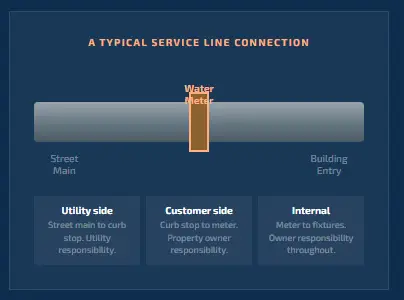
Who owns which part of the lead service line
From the main to the curb stop
The water utility typically owns and is responsible for the section of service line from the water main in the street to the curb stop valve, usually located near the sidewalk. In NYC, DEP owns and replaces the city-side portion. NJ utilities have their own delineations. Replacement of the utility-side portion is funded by the utility and is free to property owners in most replacement programs.
From curb stop to building meter
The property owner owns and is responsible for the section from the curb stop valve through the building foundation to the water meter. This is the “customer side” of the service line. In many replacement programs, utilities offer funding assistance or zero-interest loans for the customer-side replacement that must accompany utility-side work, since partial replacement one side only can temporarily worsen lead levels by disturbing the pipe.
Identifying Your Service Line Material
Three ways to determine if your service line is lead
The scratch test
Find the service line where it enters your building near the water meter. Scratch the surface lightly with a key or coin. Lead is soft and will show a bright silver scratch mark. Galvanized steel is hard and will not scratch. Copper is orange-brown. The scratch test is the most reliable non-invasive identification method.
The magnet test
Hold a magnet to the pipe near where it enters the foundation. Steel and galvanized steel are strongly magnetic. Lead and copper are not magnetic. A pipe that does not attract a magnet is either lead or copper — use the scratch test to distinguish between them.
Utility LSL inventory
NYC DEP and most NJ utilities maintain searchable lead service line inventories. Enter your property address to check the utility’s records for your service line material. These inventories are required by the EPA’s Lead and Copper Rule Revisions (2021) and must be publicly available. Records may be incomplete for private-side connections.
Replacement & Funding Questions
What property owners most need to know about LSL replacement
What is a lead service line?
A lead service line is the pipe that connects a home, apartment building, or commercial property to the public water main in the street. In older cities, some of these service lines were made from lead because it was once a commonly used plumbing material. The service line may include a city-owned or utility-owned portion and a private property portion, depending on the local water system. If the pipe contains lead, corrosion can cause lead to enter drinking water as it travels from the main into the building. Lead service lines are often underground, so property owners may not know the material without checking records, inspecting visible pipe sections, or contacting the local water provider. Identifying a lead service line is an important first step in understanding potential drinking water risks and planning replacement when needed.
Are lead pipes still present in older cities?
Yes, lead pipes and older lead-containing plumbing materials may still be present in many older cities. Neighborhoods with historic homes, brownstones, row houses, apartment buildings, and older commercial properties are more likely to have aging plumbing infrastructure. Cities such as New York, Jersey City, Hoboken, Newark, and other older urban areas may contain service lines or interior plumbing that were installed before modern plumbing safety rules. Even when a building has been renovated, some underground pipes, solder joints, fittings, or older fixtures may remain in place. In many communities, utilities and city agencies are working to identify lead service lines and replace them over time. However, because these pipes are often buried or located within private property, identification and replacement can take time and may require coordination between utilities, property owners, and licensed plumbing professionals.
How can lead enter drinking water?
Lead can enter drinking water when water passes through plumbing materials that contain lead and those materials begin to corrode. This may include lead service lines, lead solder, older brass fixtures, faucets, valves, or connectors. The water source itself may not contain lead, but lead can be picked up as treated water travels through older pipes and plumbing before reaching the faucet. Several factors can affect how much lead enters the water, including pipe age, water chemistry, temperature, corrosion control, and how long water sits unused inside the plumbing system. Water that remains in pipes overnight or for several hours may have more contact with lead-containing materials. Testing water from the tap can help identify whether lead may be present and whether further inspection or replacement should be considered.
Why do older buildings sometimes have higher lead risks?
Older buildings may have higher lead risks because many were constructed before current plumbing regulations limited or banned lead in pipes, solder, and fixtures. Brownstones, older apartment buildings, row homes, and historic residential properties may have plumbing systems that were installed, repaired, and updated at different times. As a result, one part of a building may have newer plumbing while another section still contains older materials. Underground service lines can also remain unchanged for decades because they are difficult to see and expensive to replace. In dense urban areas, plumbing systems may be complex, with shared lines, older meters, and multiple renovation phases. These conditions can make it harder to identify every source of possible lead exposure. For this reason, older buildings often benefit from plumbing inspections, service line checks, and water testing.
How can homeowners determine if plumbing contains lead?
Homeowners can start by contacting their local water provider or city agency to ask whether service line material records are available for their property. Some cities provide online maps or service line inventories that show whether a property may have a lead, galvanized, copper, or unknown service line. Homeowners can also inspect the visible pipe where the service line enters the basement, utility room, or meter area, but professional confirmation is often recommended. A licensed plumber can help identify pipe materials, fittings, solder, and fixtures that may contain lead. Water testing through a certified laboratory can also help determine whether lead is present at the tap. Because lead may come from the service line, interior plumbing, or fixtures, combining records, visual inspection, professional evaluation, and water testing gives the clearest understanding.
Replacement Program Reference
The Lead and Copper Rule Revisions: what utilities must now do about LSLs
Inventory Requirement
Every public water system must create and maintain a complete inventory of service line materials for every connection in the system. This applies to both the utility-owned portion (from the main to the meter) and the customer-owned portion. Systems were required to submit initial inventories and must make them publicly available. If material is unknown, the LCRR requires utilities to classify it as lead for replacement priority purposes.
Replacement Rate Mandate
Systems with lead service lines must replace a minimum of 3% of their LSL inventory per year. At that rate, a system with 10,000 LSLs would complete replacement in approximately 33 years. Some advocates note this pace is inadequate given the health urgency — Newark, NJ completed full replacement in 18 months by prioritizing the program and securing external funding. The 3% is a floor, not a target.
Partial vs. Full Replacement
Why partial lead service line replacement can temporarily increase lead levels
A lead service line typically has two sections: the utility-owned portion running from the water main to the property line, and the customer-owned portion extending from the property line to the building’s meter. If only one section is replaced, the remaining lead pipe may form a galvanic connection with the new copper or other piping. This can accelerate corrosion at the junction and release lead particles into the water, sometimes at levels higher than before the work.
Studies of partial replacements have found that elevated lead levels can persist for weeks or months afterward. Under the Lead and Copper Rule Revisions (LCRR), partial replacements generally do not count toward full lead service line replacement requirements, subject to applicable regulatory provisions. If records indicate that only part of your property’s service line has been replaced, contact your water utility to discuss completing the replacement. For additional insight into potential lead exposure, Water testing for condominiums in Brooklyn may also be relevant to property owners assessing their building’s water quality.
After any service line work near your property:
- ▸Run cold water from all taps for 5+ minutes immediately after any utility work on the street or service connection
- ▸Use bottled water for drinking and cooking for 1–2 weeks following replacement work
- ▸Request follow-up water testing from the utility or independently after 2 weeks
- ▸Clean all faucet aerator screens — particulate dislodged during line work collects in aerator mesh
How to Check Your Property
Three ways to determine if your property has a lead service line
1. Check the utility’s LSL inventory
LCRR requires utilities to publish their service line inventories. NYC DEP and NJ water utilities maintain searchable databases. Search your address — the inventory will show material type for both utility and customer-owned segments if known.
2. Physical inspection at the meter
The pipe entering your building at the meter box can be inspected visually and physically. Lead pipe is dull gray (not shiny like copper), soft enough to scratch with a key, and does not ring when tapped. Copper makes a metallic ring and develops a green patina. Galvanized is silver-gray and will attract a magnet.
3. Water testing
A first-draw lead test after 6+ hours of stagnation will tell you what is actually in your water regardless of pipe material identification. A result above 5 ppb warrants further investigation of the supply pathway regardless of what the utility inventory shows.